
programmable nanogel platform for multi-dimensional control over anticancer drug delivery
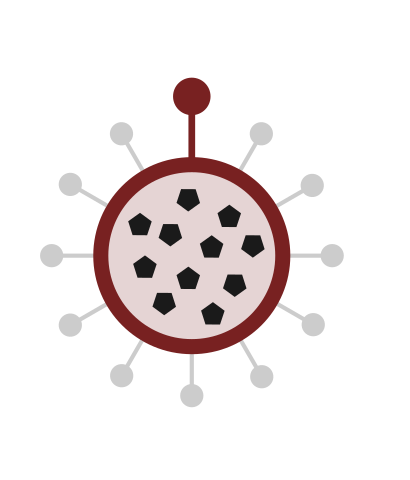
Set the payload
Stable drug conjugation with high payload capacity - up to ~30,000 drug molecules per nanogel.

Target the tumor
Active targeting through tumor-relevant receptors, with a wide, target-agnostic range of ligands.
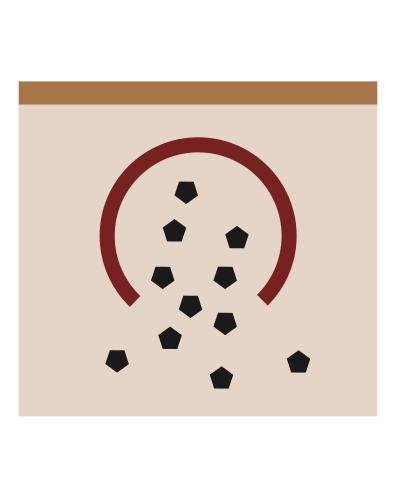
Trigger the release
Stable in circulation, activated inside tumor cells by dual pH and redox triggers.
The problem
Chemotherapy works. But it needs to know where to go.
Chemotherapy remains effective, but its lack of selectivity causes systemic toxicity and dose-limiting side effects. Targeted systems such as antibody-drug conjugates (ADCs) and nanocarriers were developed to address this - yet each carries trade-offs.
ADCs can suffer from limited tumor penetration, heterogeneous receptor expression, and high manufacturing complexity. Many nanocarriers still rely on passive targeting and offer limited control over drug release.
Redoxa layers three programmable control mechanisms - stable drug conjugation, receptor-mediated active targeting, and pH/redox-triggered intracellular release - into a single, fully synthetic nanogel platform.
How Redoxa compares
Overcoming key trade-offs of ADCs and nanocarriers
Set the payload
- ADCs
- Low payload, 2-8 drugs per antibody
- Nanocarriers
- Mostly physical / electrostatic loading
- Redoxa
- Covalent + high-capacity loading
Target the tumor
- ADCs
- Active, selective
- Nanocarriers
- Often passive accumulation (EPR)
- Redoxa
- Active, selective, wider range of targets
Trigger the release
- ADCs
- Cleavable linker
- Nanocarriers
- Often passive / gradual release
- Redoxa
- Tumor-responsive pH + redox release
Development & IP
Validated science, protected platform
- Multiple nanogel chemistries synthesized and characterized
- Validated trigger-sensitive release and cancer cell selectivity
- First in-vivo anti-tumor efficacy demonstrated
Next milestone: select the lead payload-indication pair, expand CD320/VB12-mediated uptake, biodistribution, tolerability, and in-vivo efficacy data - and initiate CMC and scalable manufacturing development.
Patent applications
P.449342
Oxidation/reduction and pH-sensitive crosslinking agent for radical polymerization and degradable polymer nanogels as drug carriers
Patent Office of the Republic of Poland, 2024
P.448586
Glutathione-sensitive monomer N-acryloylcysteine and polymers for intracellular, controlled drug delivery
Patent Office of the Republic of Poland, 2024
EP254600005.9
Vitamin B12-modified monomers and microgels for targeted drug delivery
European Patent Office, 2025
Partners


Let's talk partnering
We are currently finalizing the spin-off process, and focusing on lead selection, translational validation, and pharma licensing or co-development discussions.
Get in touchIP protected · Published science · In-vitro validation